
By
Rhonda Hinther
March 2025
Print Version
What you need to know
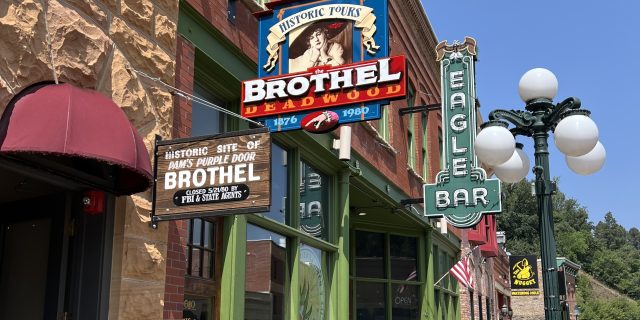
This project examines how sex workers, their lives, work, and experiences are interpreted in North American brothel museums housed in former working brothels. It also documents the material culture of brothels from the mid-nineteenth century to the 1980s. North America is home to five such museums: the Dumas Brothel Museum in Butte, Montana; the Oasis Rooms in Wallace, Idaho; the Deadwood Brothel Museum in Deadwood, South Dakota; the Old Homestead House Museum in Cripple Creek, Colorado; and the Red Onion Saloon and Brothel Museum in Skagway, Alaska.
Why this research is important
All of these museums employed primarily women sex workers and are located in settler communities established in the later nineteenth century, with economies built primarily on mining. Sex workers were critical players in local service industries that expanded to meet the needs of the mines and miners and processes of settler colonialism more broadly. Despite this, sex workers are often marginalized in or excluded from historical accounts, and their stories are rarely represented in public history spaces like museums. Spotlighting brothel museums draws attention to some of their workplaces and experiences while turning a critical eye to sex workers’ treatment at these and other historic sites.
How this research was conducted
The work began with careful background research on each museum, its specific historical context, and the communities in which they are found. Next came preliminary site visits and tours of the four museums in the contiguous United States, along with an exploration of other area historic sites and museums for additional place-specific context. Careful photographic documentation and note-taking underpin the project’s analysis. Further research funding is being sought to facilitate visits to Skagway and return visits to each museum for additional research, including oral history interviews and further archival and place-based investigation.
What the researcher found
Each museum visited exhibited an incredible array of content, especially artifacts, much of it uninterpreted and even largely untouched in some cases from how the women workers left it when the brothels shut down in the early 1980s. Early impressions suggest each of these museums treats sex workers respectfully while highlighting, to differing degrees, the challenges and dangers inherent to the livelihood. Most spaces have retained a feeling of historical authenticity and provide visitors with varying degrees of an immersive experience.
Challenges of representation exist, however, as these spaces exhibit primarily white settler colonial sex workers’ experiences. A dearth of Indigenous and other racialized or otherwise marginalized sex workers stories, many of whom carried out their trade outside of the (however precarious) protection brothel walls afforded, help to serve and reinforce the erasure of these othered women from the public history discourse. Absences in these brothel museums are, in many ways, as important as what is present.
This ultimately points to the challenges of public history and the need to accurately and respectfully represent marginalized and criminalized constituencies. Like other historic sites and houses, brothel museums demonstrate the difficulties of comprehensively representing the past in public history spaces and the limits of these forms of storytelling. For a fuller and more inclusive public history of sex work, its spaces of interpretation must be expanded. Essential is the commemoration and interpretation of diverse sites of work—such as alleys, parks, and other outdoor places—and acknowledgement of the degrees of privilege that have historically existed among sex workers themselves.
How this research can be used
This research is valuable to sex worker communities, the museums being studied, and other museums, especially historic houses. It has important implications for the tourism industries promoting historical tourism. It is also helpful for potential visitors planning visits to these sites.
Acknowledgements
Brandon University Research Committee funding generously supported the initial stages of this project’s development and some of its knowledge mobilization efforts.
Research Connection has been made possible by the Research Support Fund through the Office of Research Services.
About the Researcher
Keywords
- material culture
- museum studies
- public history
- sex work history
Publications Based on the Research
Dr. Hinther is working to expand this research by applying for a SSHRC Insight Development grant in the fall of 2025.
Editor: Christiane Ramsey
Read more BU Research
Research at Brandon University follows comprehensive policies designed to safeguard ethics, to ensure academic integrity, to protect human and animal welfare and to prevent conflicts of interest.