
By
Emily Holland
April 2025
Print Version
Trigger warning: Discussion of residential schools, MMIWG2S+ and human remains
What you need to know
This is not research per se, but rather socially responsive, and community engaged forensic anthropology that highlights the ways in which academia can make meaningful applied contributions to Truth and Reconciliation and issues of Missing and Murdered Indigenous Women and Girls and Two-Spirited people (MMIWG2S+).
Why this engagement is important
Engaging with and actively working with communities, particularly Indigenous communities, ensures they have the necessary information to make informed decisions on how they want to move forward with residential school investigations or a search for missing people. Part of this engaged work is helping build capacity by training community members on the search process and excavation. Doing so can help communities maintain control of their own histories and contribute to self-determination, the loss of which has been determined to be a root cause of violence against women and girls.
Indigenous-led residential school investigations are pivotal to Truth and Reconciliation and directly address TRC Calls to Action 73 (plot maps for deceased children), 74 (reburial in home communities) and 74 (location of all cemeteries and other sites where children were buried). It is paramount that the people leading these investigations have the knowledge they need to determine how to move forward.
Issues of MMIWG2S+ are ongoing and directly affect communities across Canada. Indigenous people accounted for 25 % of all homicide victims between 2014–2022 but represent only 5% of the population. Indigenous women account for 10% of all missing women in Canada, are 16 times more likely to become missing than Caucasian women and are more likely to be homicide victims (NIMMIWG, 2019). The National Inquiry into MMIWG articulated 231 Calls to Justice and highlighted the loss of self-determination as a root cause of violence against Indigenous women and girls. Training Indigenous community members and listening to and engaging with Indigenous leadership regarding the search of the Prairie Green Landfill and providing expertise on how to move forward provided the opportunity for communities and affected families to regain a sense of self-determination.
How the work was conducted
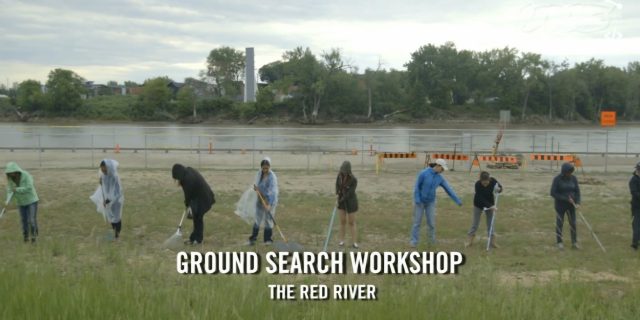
My collaborations and engagement with communities have been in direct response to requests from communities and/or organizations. Since 2015, I have organized and run yearly workshops for Drag the Red, an Indigenous-led grassroots organization devoted to searching the Red River and its banks for evidence of missing people (Vice Media [Video]). These workshops help ensure that people doing the work do so safely, effectively and efficiently, and if they find anything, I am available to assist. I have worked with Sioux Valley Dakota Nation (SVDN) on the Brandon Residential School and Cemeteries Project since 2018 and worked with Pine Creek First Nation (PCFN) on their residential school investigation and the excavation of the basement of the church (CBC News [Video]) in which there were reflections identified through ground penetrating radar. Finally, I have been involved with the search of the Prairie Green Landfill since December 2022, first as an expert and co-chair of the Technical Subcommittee of the Landfill Search Feasibility Study Committee for the Assembly of Manitoba Chiefs, and since June 2024, as the forensic anthropologist and search director of the Humanitarian Search of the Prairie Green Landfill (PGL) for the Government of Manitoba.
What the outcomes were
The outcomes across all community engagement include community capacity building that helps ensure communities maintain their sovereignty regarding the work they do; they choose when to do the work, how and with whom. SVDN has a fully trained team in charge of their investigation and is in a position to help others. Members of PCFN have been trained in excavation and are well-placed to continue to do such work. People trained through Drag the Red have the skills necessary to assist with searches across Manitoba. Finally, the recovery of the remains of Morgan Harris and Marcedes Myran from the PGL illustrates how successful partnerships and engagement work to provide meaningful closure.
How this engagement can be used
Engaged forensic anthropology is an example of actionable steps towards decolonizing forensic anthropology by having historically excluded voices (communities) involved at various, if not all, stages of these projects/works, working with and for Indigenous communities. This is clear evidence of the ways in which academia can leverage expertise to help communities move forward and make steps towards following the United Nations Declaration of Human Rights for Indigenous Peoples (UNDRIP) and ensuring Indigenous involvement and maintenance of their histories and legacies.
Acknowledgements
Sioux Valley Dakota Nation, Pine Creek First Nation & search team members, Drag the Red, Minister Smith, Sandra DeLaronde, the families of Morgan Harris and Marcedes Myran, members of the Technical Subcommittee, and all team members from the Humanitarian Search of the PGL.
Research Connection has been made possible by the Research Support Fund through the Office of Research Services.
About the Researcher
Keywords
- forensic anthropology
- MMIWG2S+
- residential schools
- Truth and Reconciliation
Publications Based on the Research
Final Report of the Technical Subcommittee of the Landfill Search Feasibility Study Committee
Editor: Christiane Ramsey
Read more BU Research
Research at Brandon University follows comprehensive policies designed to safeguard ethics, to ensure academic integrity, to protect human and animal welfare and to prevent conflicts of interest.