
By
Ayat Baig
April 2025
Print Version
What you need to know
The Micro-Analytical Facility (MAF) was originally established in 2009 and is located in the Department of Geology at Brandon University.
The MAF conducts collaborative multidisciplinary research focused on material identification and analysis, working on a wide range of diverse projects. The facility also houses the newly upgraded Manitoba Mineral Analytical Facility (MMAF), which offers specialized services for the environmental, exploration, mining and mineral sectors in Canada.
Why this research is important
Whether it is conducting research to pinpoint the original sources of our ancestral Indigenous communities’ artifacts, to building more sustainable and environmentally friendly roads, to aiding and conducting research for mineral exploration and resource development, our research is geared towards studying our Earth’s past environments and climate, learning from our Indigenous communities, and creating a more sustainable and prosperous future for all.
How the research is conducted
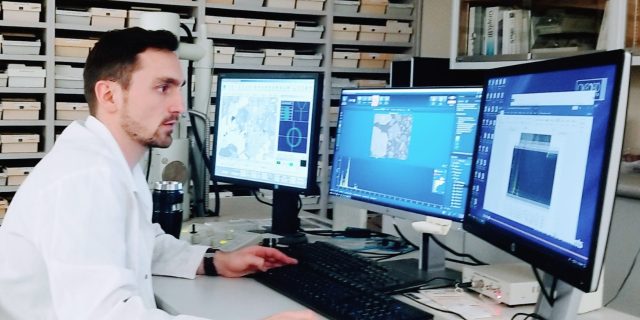
The MAF team meets with research collaborators and clients to develop our projects on a case-by-case basis, as every project is unique and requires specific scientific inquiries. The MAF is comprised of several laboratories ranging from sample preparation, high-powered optical light microscopy, x-ray diffraction to scanning electron microscopy equipped with state-of-the-art detectors for elemental identification and geochemical analysis. This equipment provides high-resolution imaging, material identification, chemical quantification, and detailed ore and resource characterization.
Some examples of the diverse research we are currently conducting includes:
1. critical mineral and resource development in Manitoba—rock identification, ore characterization, metallurgical studies, environmental mitigation, etc.;
2. archaeology and anthropology—fur trade axe and pipestone artifact analyses;
3. visual arts and ceramics—clay sourcing and material analysis;
4. environmental—road stabilization materials, and dust suppression; and
5. biology and environment—anthropogenic effects on ecosystems and biophysical environments (i.e. microplastics, insecticides, etc.).
How this research can be used
Mine development and exploration
• Characterization of minerals
• Early indicators of mineral recoveries
• Assessment of diamond indicator minerals
• Geometallurgical mapping of ore bodies
Mineral processing and metallurgy
• Identification and measurement of mineral quantities and estimate of recoveries
• Determination of mineral associations and liberation parameters
• Characterize metallurgical products from smelting, refining and hydrometallurgy
Mining and the environment
• Characterization of mine tailings, waste rock, slags, leach residues and sludges
• Mineralogical balances for contaminants
• Speciation and distribution of heavy metals
• Quantification and distribution of acid generating and neutralizing minerals
Forensic science/anthropology
• Gun shot residue analysis
• Dental and bone imaging
• Identifying artifacts and their source material
Material Removal
• Asbestos identification
• Analysis of filter materials
Failure analysis
• Imaging to determine causes of failure to prevent recurrence; often used in the electronics and automotive industries
Biology
• High magnification, high resolution imaging of biological specimens
• Identifying pollutants and the effect of anthropogenic activities
Acknowledgements
Funding for the Micro Analytical Facility was provided by Prairie Economic Diversification Canada, Brandon University, Chevron Standard, VMS Ventures Ltd, Harvest Gold Corp, Gossan Resources, Rockcliff Resources Inc., Tundra Oil and Gas Ltd, Cabot Corp, Tantalum Mining Corp of Canada, Manitoba Innovation Fund, Joe Brain Foundation, and Tikal Resources Corp.
Research Connection has been made possible by the Research Support Fund through the Office of Research Services.
About the Researcher
Keywords
- anthropogenic
- archaeology
- critical minerals
- development
- metallurgy
- sustainability
Editor: Christiane Ramsey
Read more BU Research
Research at Brandon University follows comprehensive policies designed to safeguard ethics, to ensure academic integrity, to protect human and animal welfare and to prevent conflicts of interest.