
Tom Mitchell
Researcher's site: Tom Mitchell
This researcher is available for inquiries from the public.
This researcher is available for media inquiries.
Contact Information
Email: mitchellt@brandonu.ca
Phone: 204 727 9634
Research Interests
These days, I am working on projects concerned with the history, legal character, and historical impact of Canadian public inquiries. One study – Strike or Revolution – Hugh Robson’s Inquiry into the Winnipeg General Strike – has appeared (Manitoba Law Journal). The results of a second probe dealing with the origins of Canada’s first Inquiries Act (1846) resulted in a paper published in the Journal of Canadian Studies (53.3.2021) setting out the unusual historical circumstances that prompted the beginning of a unique Canadian tradition in public inquiries. An examination of the place of the Mathers (1915) inquiry – Manitoba Legislative Building corruption and the fall of the Roblin government – in the history of Canadian executive inquiries was also published in the Manitoba Law Journal.
Research into the probe of Russian espionage in Canada c. 1946 triggered by the defection of Soviet military intelligence officer Igor Gouzenko 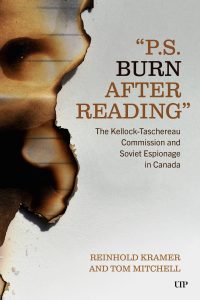 turned into a book length project. P.S. Burn After Reading – The Kellock-Taschereau Commission and Soviet Espionage in Canada, written with Reinhold Kramer, will be published by the University of Toronto Press in 2026. We were invited to contribute to another publication concerning security and intelligence. Watch for “McClung’s Guide to Canadian Moles: a K-Branch Commentary on Cold War Ideological Spies,” in Michel S. Beaulieu, David Ratz, Kari Alenius, & Tyler Wentzell, eds. Active Measures: Historical and Contemporary Perspectives of Foreign Interference, Espionage, and National Security (working title) UBC Press. (forthcoming)
Prompted by British-Australian historian Christopher Clark’s fine Revolutionary Spring – Europe Aflame and the Fight for a New World, 1848-1849, his history of the 1848-49 Europe-wide revolt, some unfinished business concerning the Canadian distemper of 1919 has presented itself. In Revolutionary Spring, Clark rejects any limited national focus on the troubles of 1848-49. “These revolutions were experienced as European upheavals – the evidence for this is superabundant; but they were nationalized in retrospect. The historians and memory managers of the European nations absorbed them into specific national stories.” Clark places this distortion at the center of the contemporary memory of 1848-49. “These connected upheavals and their fragmentation in modern memory [demonstrates] the immense power of the nation-state as a way of framing the historical record – we are still feeling that power today.”
Is Clark’s observation applicable to the current historical memory of the Canadian labour strife of 1919? Have Canadian memory managers (historians – public and academic – fiction writers, documentarians, among others) domesticated the labour revolt of 1919 when Canadian strikers and their supporters may have experienced it as a transnational rising, something more than a local or national moment? Did those who opposed the strikers also sense that they were part of something that defied political and geographical boundaries? The manufacture of historical memory is a complicated process with often surprising and unstable outcomes. Soviet joke: “Only the future is certain: the past is unpredictable.” (TLS 27 June 2025) Is it possible to reveal the provenance of our current historical accounting (memory) of 1919? What is the fate (so far) of the Winnipeg General Strike in public memory? Is our current historical memory of 1919 false, skewed in some way by “the immense power of the nation-state as a way of framing the historical record?” A question worth exploring.
Research Area
Canadian Social, Labour, Legal, Security and Intelligence History
Keywords
archives; Winnipeg General Strike; labour history; commissions of inquiry; social history, immigration crime, class, gender; Soviet espionage in Canada; history of education; historical geography eastern prairies
Field(s)
Other